
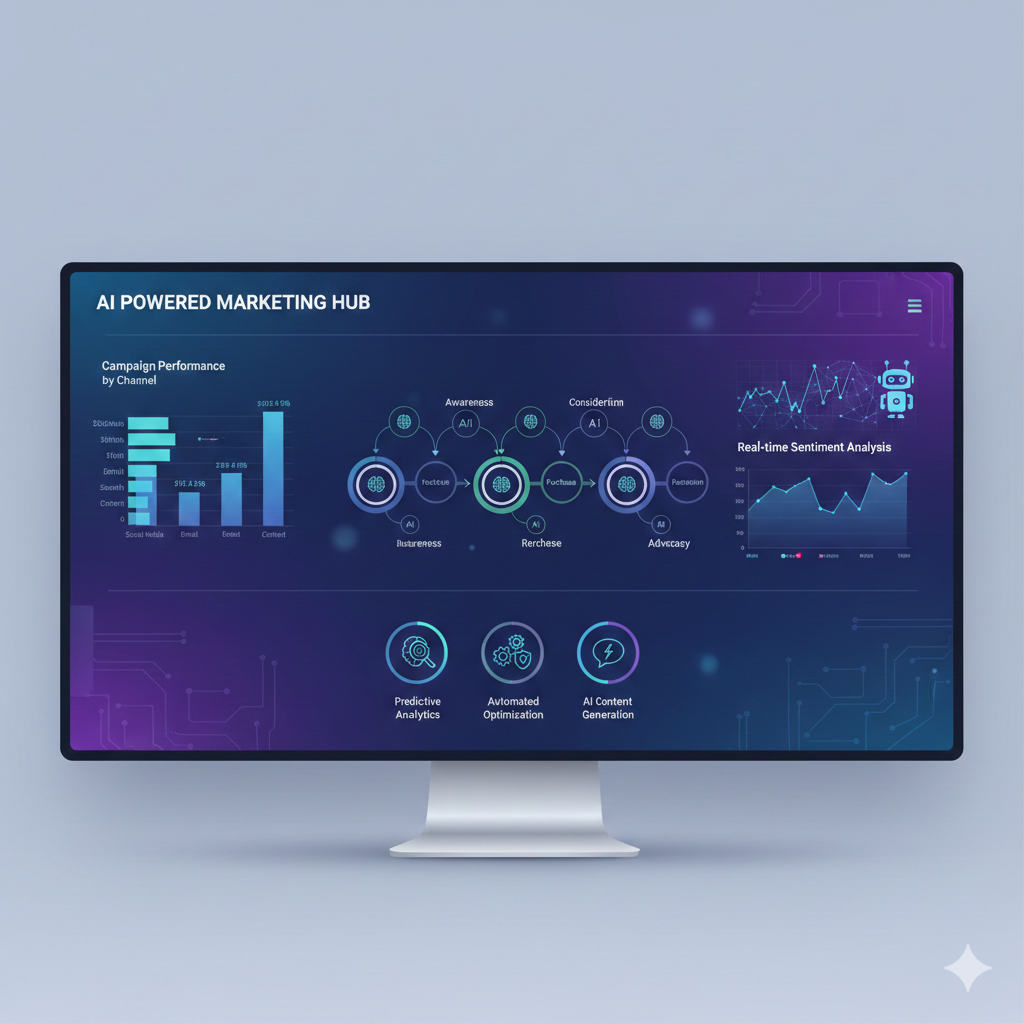
Introduction to AI in Marketing
Artificial intelligence (AI) has rapidly transformed numerous industries, and marketing stands out as one of its most significantly impacted domains. At its core, AI encompasses a range of technologies that simulate human intelligence to perform tasks that traditionally require human thought processes. These technologies include machine learning, natural language processing, and deep learning, enabling systems to analyse data and make decisions based on that analysis.
In recent years, the evolution of AI technology has accelerated dramatically, driven by advancements in computational power, data availability, and algorithmic sophistication. This evolution has made it increasingly feasible for marketers to harness AI-driven tools to enhance their strategies, optimise campaigns, and personalise customer interactions. For instance, AI applications in marketing can analyse consumer behaviour, segment target audiences, and even predict future buying patterns with remarkable accuracy.
The increasing adoption of AI in marketing is attributed to its ability to generate actionable insights that significantly improve decision-making processes. Companies of all sizes are beginning to recognise the necessity of incorporating AI technologies into their marketing efforts to foster engagement with their audiences. As competition intensifies, marketers must adapt to this changing landscape; staying informed about AI’s capabilities is paramount for crafting effective campaigns and enhancing customer experience. By embracing AI tools and technologies, marketers not only streamline their operations but also position themselves at the forefront of industry innovation.
Understanding Customer Behaviour with AI
In the realm of modern marketing, understanding customer behaviour is paramount for crafting effective strategies. Artificial Intelligence (AI) offers robust tools to analyze vast amounts of customer data, revealing deep insights into behaviours, preferences, and purchasing habits. By leveraging machine learning algorithms and data analysis techniques, marketers can segment audiences more accurately and predict their needs with unprecedented precision.
AI-driven analytics tools utilize customer data from various sources, including social media interactions, website activity, and sales history. These tools can identify patterns that humans might overlook, such as the time of day customers are most likely to purchase, or the types of products frequently bought together. This information is invaluable for creating targeted marketing campaigns that resonate with specific customer segments.
Moreover, AI systems can continuously learn and adapt, improving their predictive capabilities over time. For instance, by analyzing past consumer behavior, AI can forecast future trends, enabling marketers to proactively address customer needs. This dynamic approach ensures that marketing efforts are not only reactive but also anticipatory, enhancing overall customer satisfaction.
Another significant application of AI in understanding customer behaviour is through sentiment analysis. AI can process customer feedback from various channels and quantify customer sentiments towards products or services. This insight allows businesses to adjust their marketing strategies in real-time, ensuring that they align with consumer expectations.
As marketers strive for a deeper understanding of their customers, the integration of AI tools becomes increasingly essential. These tools empower marketers to gain insights that drive effective segmentation and personalised marketing strategies. By harnessing the capabilities of AI, businesses can create more relevant and compelling marketing messages that meet their customers’ needs and enhance the overall customer experience.
AI-Powered Content Creation
In the rapidly evolving landscape of digital marketing, AI-powered content creation tools have emerged as game changers. Utilising advanced technologies such as natural language processing (NLP), these tools are capable of generating a diverse array of content, from informative articles to engaging social media posts and personalised emails. The ability of AI to analyse vast amounts of data allows marketers to create tailored content that resonates more with their audience, ultimately enhancing customer engagement.
One of the primary benefits of AI-driven content generation is the significant time savings it offers. Marketers often face tight deadlines and the pressure to consistently produce high-quality material. Automation in content creation alleviates this burden, allowing teams to focus their efforts on more strategic initiatives. By leveraging AI, businesses can quickly generate initial content drafts, which can then be refined and edited to align with brand voice and messaging. This not only streamlines the production process but also boosts overall productivity.
Furthermore, consistency in content creation is crucial for maintaining brand integrity. AI tools can be programmed to adhere to specific guidelines and style preferences, ensuring that every piece of content produced meets the desired standards. This allows for a more uniform experience across various channels, whether it be in blogs, newsletters, or social media platforms. By utilising AI for content generation, companies can forge stronger connections with their audiences through relevant and cohesive messaging, thereby enhancing brand loyalty.
As businesses continue to embrace digital transformation, the integration of AI in content creation is becoming indispensable. By adopting these innovative solutions, marketers can not only optimise their content creation processes but also enhance the quality and relevance of their output, making a significant impact on their overall marketing strategies.
Artificial Intelligence (AI) has emerged as a powerful tool in the realm of marketing, particularly in the area of personalisation and customer experience enhancement. By harnessing sophisticated algorithms and machine learning techniques, businesses can offer hyper-personalised experiences that significantly elevate customer engagement. One of the most effective applications of AI in this domain is the development of recommendation systems, which analyse user behaviour and preferences to suggest tailored products and services.
These recommendation systems leverage vast amounts of data collected from various sources, such as browsing history, purchase patterns, and customer feedback. By employing AI, marketers can predict what products a customer is likely to be interested in and present these suggestions at the opportune moment. For instance, streaming platforms use AI to recommend movies and shows based on individual viewing habits, thereby enhancing user experience and driving higher satisfaction levels.
Moreover, the use of AI in crafting personalised marketing campaigns can lead to improved retention rates. When customers feel that their unique preferences are acknowledged, they are more likely to engage with the brand and make repeat purchases. By delivering tailored content and offers through email, social media, and website interactions, companies can nurture customer loyalty and foster lasting relationships.
In addition, AI-driven chatbots play a pivotal role in personalising customer interactions. These intelligent systems can engage customers in real-time, answer inquiries, guide them through the purchasing process, and recommend products based on previous interactions. The responsive nature of AI chatbots provides immediate assistance while ensuring that each interaction is relevant and meaningful to the customer.
Therefore, integrating AI into marketing strategies not only enhances personalisation but also enriches the overall customer experience. By prioritizing individual needs and preferences, businesses can create a more engaging and effective marketing landscape, driving both customer satisfaction and brand loyalty.
Chatbots and Customer Service Automation
In today’s digital environment, businesses are increasingly leveraging AI-powered chatbots to enhance their customer service operations. Chatbots serve as an effective tool for managing customer inquiries, offering instant responses, and facilitating engaging interactions. By utilising natural language processing capabilities, these intelligent systems can understand and respond to customer queries with remarkable accuracy.
The implementation of chatbots can significantly improve customer engagement. With the ability to operate 24/7, chatbots ensure that customers receive timely assistance, regardless of the hour. This continuous service availability leads to heightened customer satisfaction and loyalty, as clients appreciate instant responses to their questions or concerns. Furthermore, chatbots can manage multiple inquiries simultaneously, reducing wait times and ensuring that customers do not experience delays in receiving needed information.
Besides enhancing responsiveness, AI chatbots can also efficiently handle a broad spectrum of inquiries. From basic questions about product details to complex issues related to service support, chatbots can manage diverse topics without human intervention. This capability not only decreases the workload on customer service representatives but also reduces operational costs for businesses. By automating routine inquiries, companies can redeploy their human resources to focus on more intricate customer issues, ultimately fostering a more effective service experience.
Moreover, chatbots can analyse customer interaction data to provide insights into consumer behaviour and preferences. This information can help businesses tailor their offerings and create more personalised marketing strategies, thereby improving overall engagement. In conclusion, the integration of AI-powered chatbots in customer service represents a transformative opportunity for organisations aiming to enhance operational efficiency and customer experience.
Predictive Analytics for Marketing Strategies
Predictive analytics has become an integral facet of modern marketing strategies, utilising the power of artificial intelligence (AI) to anticipate future trends and behaviours of consumers. By analysing historical data, AI algorithms can identify patterns that allow marketers to make informed predictions about their campaigns. This capability is vital in a world where consumer preferences shift rapidly, and staying ahead of these changes can foster a competitive advantage.
One of the primary applications of predictive analytics in marketing is forecasting trends. Marketers can leverage AI-driven tools to analyse data such as past purchasing behaviours, seasonal patterns, and demographic information. With these insights, brands are equipped to adjust their strategies proactively rather than reactively, aligning their offerings with anticipated market demands. For instance, retail businesses can predict sales peaks for certain products during holidays, allowing them to optimise inventory and promotional efforts accordingly.
Moreover, predictive analytics also plays a critical role in measuring campaign effectiveness. By using AI, marketers can continually track and assess the performance of their campaigns in real time. This includes measuring key performance indicators (KPIs) such as conversion rates, customer engagement, and return on investment (ROI). These insights enable marketers to make swift adjustments to their strategies, ensuring optimal performance and alignment with their target audience’s needs.
Several predictive modelling tools are available for marketers, including platforms like IBM Watson and Salesforce Einstein. These tools utilize machine learning algorithms to analyse customer data, offering actionable insights that inform decision-making. By incorporating such AI-driven solutions, marketers can unravel complexities in consumer behaviour, enabling customised experiences that lead to higher satisfaction and loyalty.
Programmatic Advertising and AI
In recent years, programmatic advertising has revolutionised the digital marketing landscape, leveraging artificial intelligence (AI) to automate the buying and selling of ad spaces. This transformation allows marketers to engage in real-time bidding, offering immediate access to valuable advertising slots, which significantly enhances efficiency and effectiveness. By integrating AI into their advertising strategies, marketers can optimise their campaigns in ways that were previously unimaginable, streamlining the process while achieving better results.
Programmatic advertising is fundamentally data-driven. AI algorithms analyse massive amounts of data from various sources to determine the best moments to display ads to specific audiences. This targeting capability means that marketers can reach potential customers more effectively, ensuring that ads are shown to individuals who are most likely to convert. The implications of AI-driven programmatic advertising are profound, as it not only minimizes human error in decision-making but also improves the overall return on investment (ROI) for advertisers.
Moreover, the use of AI in programmatic advertising allows for enhanced personalisation. By utilising predictive analytics, AI can anticipate consumer behavior based on historical data, enabling marketers to craft highly personalised ad experiences. This personalisation can lead to increased engagement rates, as audiences are more likely to respond positively to ad content that speaks directly to their needs and preferences. As consumers become increasingly accustomed to tailored advertising experiences, the integration of AI in programmatic advertising will be an essential element in keeping brands relevant and competitive.
In conclusion, the intersection of programmatic advertising and AI is transforming how marketers engage with their audiences. By harnessing real-time bidding and automated ad placements powered by AI, brands can enhance targeting precision and achieve more personalised consumer interactions. As this technology continues to evolve, marketers will likely see even more innovative applications that will further enhance their advertising efficacy.
Ethics and Considerations in AI Marketing
The integration of artificial intelligence (AI) into marketing strategies has brought forth significant advancements and opportunities. However, the ethical implications surrounding this technology cannot be overlooked. As organisations increasingly rely on AI systems, concerns regarding data privacy, algorithmic bias, and the necessity for transparency are gaining prominence in discussions about AI in marketing.
Data privacy is a paramount consideration in the ethical application of AI in marketing. Organisations often utilise vast amounts of consumer data to enhance targeting and personalisation. Nevertheless, consumers are increasingly aware of how their data is used, leading to heightened expectations of transparency and the protection of personal information. Companies must ensure compliance with data protection regulations, such as GDPR, to uphold consumer trust while leveraging AI.
Another critical aspect is the potential for bias in algorithms. AI systems learn from historical data, which can inadvertently propagate existing biases present in that data set. This can result in discriminatory practices, especially in targeted advertising. For instance, if an AI system is trained on data that reflects societal biases, it may inadvertently target or exclude specific demographics based on flawed criteria. Hence, it is crucial for organisations to rigorously test AI algorithms, ensuring fairness and inclusivity in their application.
Moreover, transparency in AI applications is imperative for fostering consumer trust. Marketers must proactively communicate how AI influences consumer interactions, from recommending products to personalising experiences. Ensuring clarity around AI use helps demystify the technology for consumers and reinforces ethical marketing practices.
In essence, as AI continues to shape the landscape of marketing, addressing its ethical implications is vital. Companies that proactively invest in transparent, equitable, and privacy-conscious AI practices will not only enhance their marketing efforts but also build lasting relationships with their consumers.
Conclusion and Future Perspectives on AI in Marketing
As we explore the evolving landscape of artificial intelligence in marketing, it becomes evident that AI technologies are reshaping how businesses engage with their customers. Throughout this discourse, we have examined several practical use cases, ranging from customer segmentation and personalized content creation to predictive analytics and automated customer support. Each of these applications showcases how marketers can leverage AI to enhance customer experiences, streamline operations, and ultimately drive sales growth.
Looking ahead, several emerging trends in AI are poised to redefine the marketing domain further. For instance, the advancement of machine learning algorithms enables more sophisticated data analysis, allowing marketers to uncover deeper insights into consumer behaviour. Additionally, the integration of AI with other technologies, such as augmented reality and virtual reality, presents opportunities for immersive marketing experiences that were previously unimaginable. These innovations are not merely theoretical; they are beginning to be implemented in real-world marketing strategies, demonstrating the practicality and effectiveness of AI solutions.
Furthermore, the rise of ethical considerations regarding AI usage cannot be overlooked. As marketers adopt AI-driven techniques, they must ensure responsible practices, addressing concerns surrounding data privacy and algorithmic bias. This focus on ethical AI will be crucial in maintaining consumer trust and fostering a positive brand image in the future.
In conclusion, the successful integration of AI in marketing is not just a trend; it represents a fundamental shift in the marketing landscape. By staying informed about the latest advancements and actively seeking to incorporate AI into their strategies, marketers can secure a competitive advantage. Embracing these innovations today will prepare businesses to meet the challenges of tomorrow’s dynamic market environment.